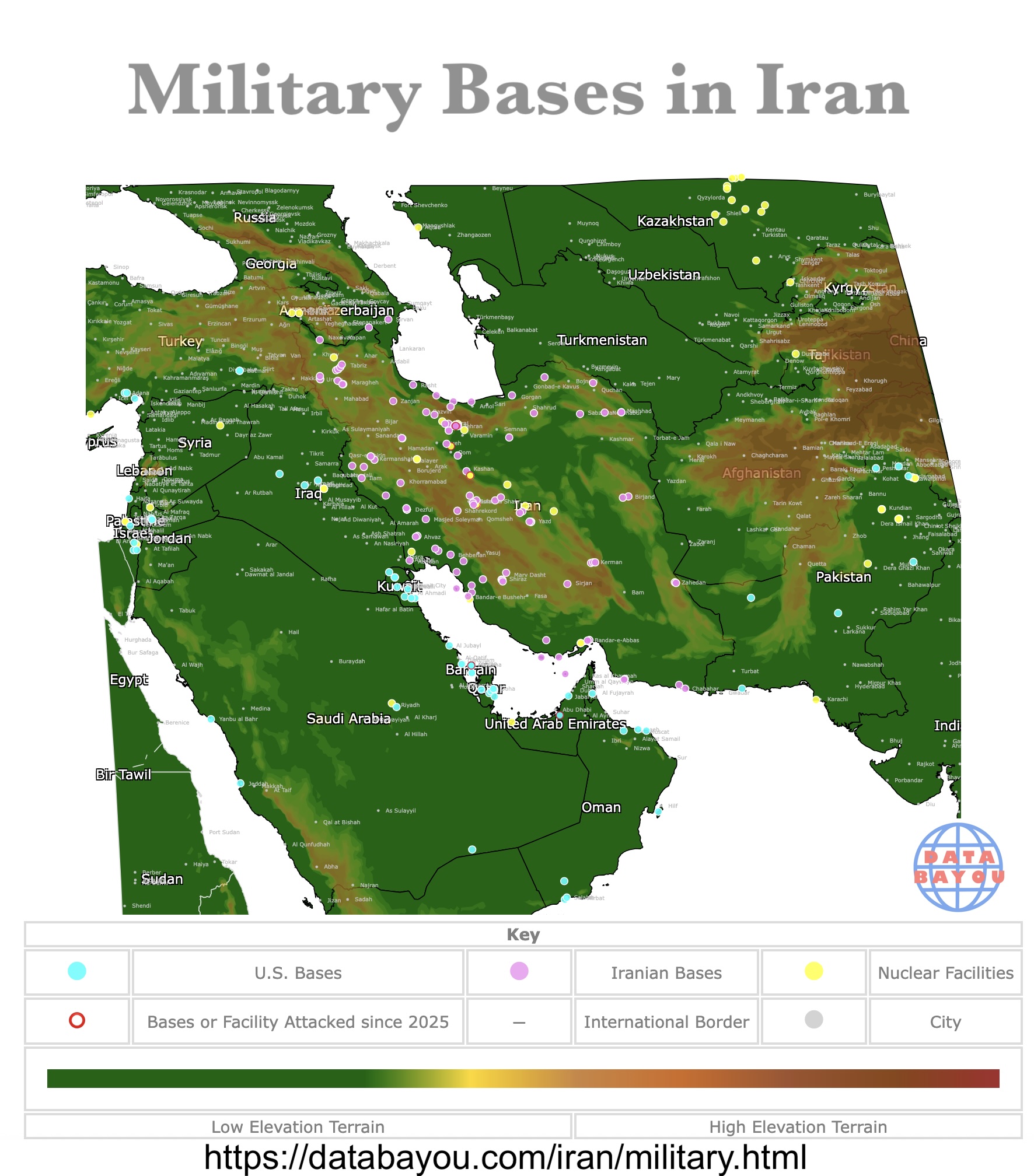
Map of Military Bases in Iran
This is an interactive map of military bases and nuclear facilities close to Iran . It displays cities, military base, nuclear facilities and the terrain in the region. For names and details hover over the map. For more information, zoom in or scroll down.
| Key | |||||
|---|---|---|---|---|---|
| U.S. Bases | Iranian Bases | Nuclear Facilities | |||
| ⭕ | Bases or Facility Attacked since 2025 | ─ | International Border | City | |
| Low Elevation Terrain | High Elevation Terrain | ||||
Military Operations in Iran
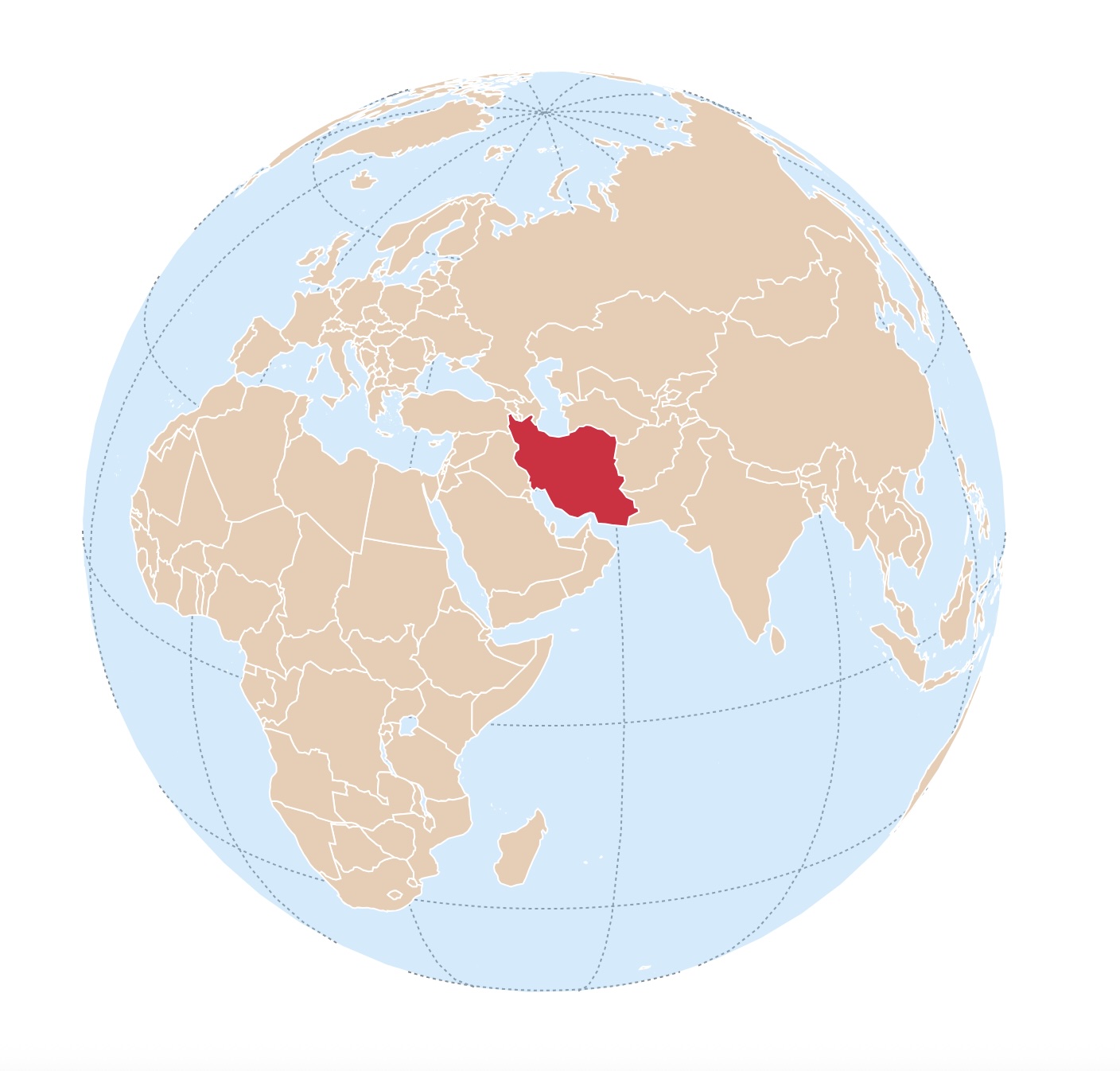
The United States and Israel launched coordinated military strikes on Iran on February 28 2026, escalating a major crisis in the Middle East.
Explosions have been reported in Tehran and other Iranian cities including Isfahan and Tabriz as part of the offensive, Operation Epic fury.
The operation has been described by the U.S. as “major combat operations” aimed at degrading Iran’s nuclear and military capabilities and countering what Washington calls an imminent threat.
U.S. and Israeli Objectives
U.S. President Donald Trump framed the mission as necessary to defend American interests and prevent Iran from becoming a nuclear threat; the strikes reportedly include targeting military infrastructure and leadership figures.
Israeli leaders said the strikes were aimed at eliminating what they regard as an existential threat posed by Iran’s military and nuclear programs.
If you find confusing who is friends with whom, I made a Middle East and Allies Friendship Chart, so you can find friends and foes in this recent conflict.
Iran’s Response
Iran’s Islamic Revolutionary Guard Corps (IRGC) has reportedly launched missile attacks at U.S. bases and assets across the Gulf region, including near Bahrain, Qatar, Kuwait and the UAE.
Iran’s government has vowed a decisive response and condemned the attacks as aggression, urging the U.N. Security Council to act.
Impact and Reactions
Panic and disruption are reported inside Iran, with civilians seeking safety, long queues for fuel, schools closed, and high civilian anxiety.
Russia’s Foreign Ministry strongly condemned the strikes as “unprovoked aggression” and warned the conflict could have serious humanitarian and regional security consequences.
If you want to learn more about Iran's point of view, Amazon has Iran's Grand Strategy: A Political History.
This book is a gripping account that overturns simplistic portrayals of Iran as a theocratic pariah state, revealing how its strategic moves on the world stage are driven by two pervasive threats—external aggression and internal dissolution
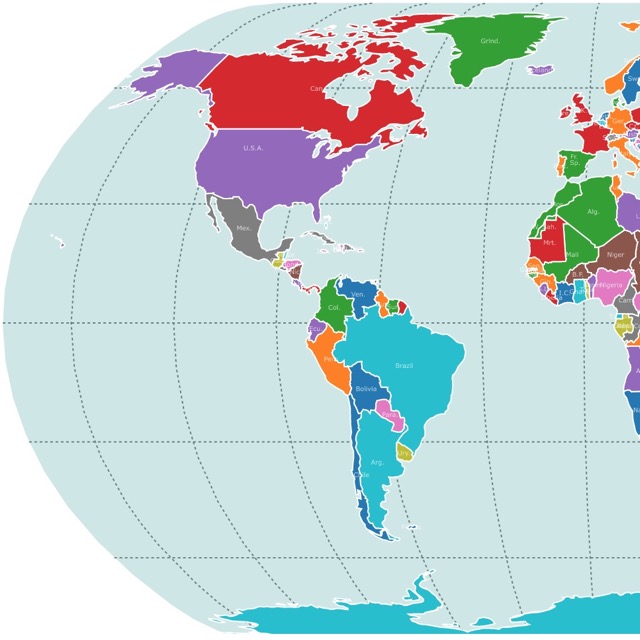
World Map
Iranian Bases Attacked in 2025
On June 22, 2025, the U.S. military executed "Operation Midnight Hammer" conducting massive airstrikes on three key Iranian nuclear sites—Fordow, Natanz, and Isfahan—using B-2 stealth bombers and submarine-launched missiles.
The strikes caused severe damage, marking a major escalation in the 2025 Israel–Iran conflict, followed by Iranian retaliatory missile launches against U.S. bases in Qatar
Attack on Iranian Nuclear Sites in 2025
The largest U.S. military action directly against Iran in 2025 occurred on June 22, 2025, when the United States launched strikes on Iranian nuclear facilities.
This operation targeted three major sites highlighted on the map above.
- Fordow Fuel Enrichment Plant
- Natanz uranium enrichment facility
- Isfahan nuclear technology center
The assault involved B-2 Spirit stealth bombers dropping GBU-57 Massive Ordnance Penetrators (bunker-buster bombs) and Tomahawk cruise missiles launched from submarines and warships.
The U.S. assessed that the strikes caused “extremely severe damage” and set back Iran’s nuclear development capabilities; Iran acknowledged significant damage.
In immediate retaliation on June 23, 2025, Iran launched missiles at the U.S. Al Udeid Air Base in Qatar, part of a broader campaign of counter-strikes against U.S. and allied forces in the region.
Qatar’s defense systems intercepted most incoming missiles.
A ceasefire was announced around June 24, halting the most intense phase of conflict between U.S./Israeli forces and Iranian targets.
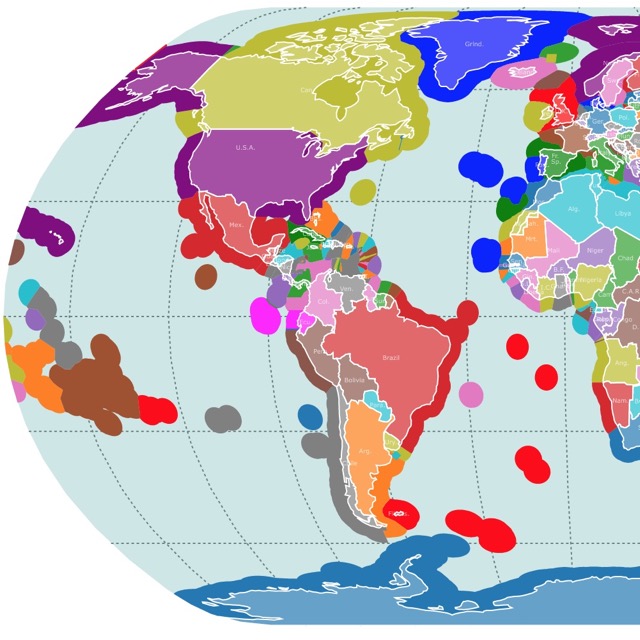
Map of Exclusive Economic Zones Worldwide
Israeli Attack in Iran (Operation “Rising Lion”) 2025
Though not exclusively a U.S. action, the Israeli military launched a significant strike on Iranian territory in June 2025, which shaped the wider conflict.
On June 13, 2025, Israel hit over 100 targets across Iran, including nuclear and missile facilities, military command centers, and leadership sites. This marked a major escalation—the most extensive Israeli strike on Iranian soil in decades.
Following these strikes, Iran responded with hundreds of ballistic missiles and drones launched toward Israel, though many were intercepted. This deepened regional hostilities in the lead-up to America’s direct engagement later in June.
U.S. Iran Conflict Background
Historical turning point: 1953 Coup
In 1953, the U.S. and the U.K. helped overthrow Iran’s democratically elected prime minister, Mohammad Mossadegh, after he nationalized the country’s oil industry.
This intervention installed the pro-Western Shah of Iran and left a long-lasting legacy of distrust toward the U.S. among many Iranians.
1979 Islamic Revolution and Hostage Crisis
In 1979, a popular revolution overthrew the Shah and brought Ayatollah Khomeini’s Islamic Republic to power.
Later that year, Iranian students seized the U.S. Embassy in Tehran and held 52 American diplomats and citizens hostage for 444 days. This crisis deeply damaged relations and led to decades of hostility.
Ideological and strategic rivalry
The Iranian government’s theocratic, anti-Western ideology opposes American influence in the Middle East, while the U.S. views Iran as a destabilizing actor in the region.
The U.S. accuses Iran of supporting militant groups (like Hezbollah, Hamas, and Houthi rebels) and of pursuing nuclear weapons ambitions — accusations Tehran denies or frames as defensive.
Follow Me




Resources for Iran Military Bases Map
The shapefiles with the world's countries and cities were obtained from Natural Earth.
Nuclear facilities locations from Explore Nuclear.
Military bases in Iran OSM.
U.S. Military bases Github.
Other military bases in Iran The Nuclear Threat Initiative .
This map will be updated with new data! To receive updates on this and more maps, join my email list!!!!!!!