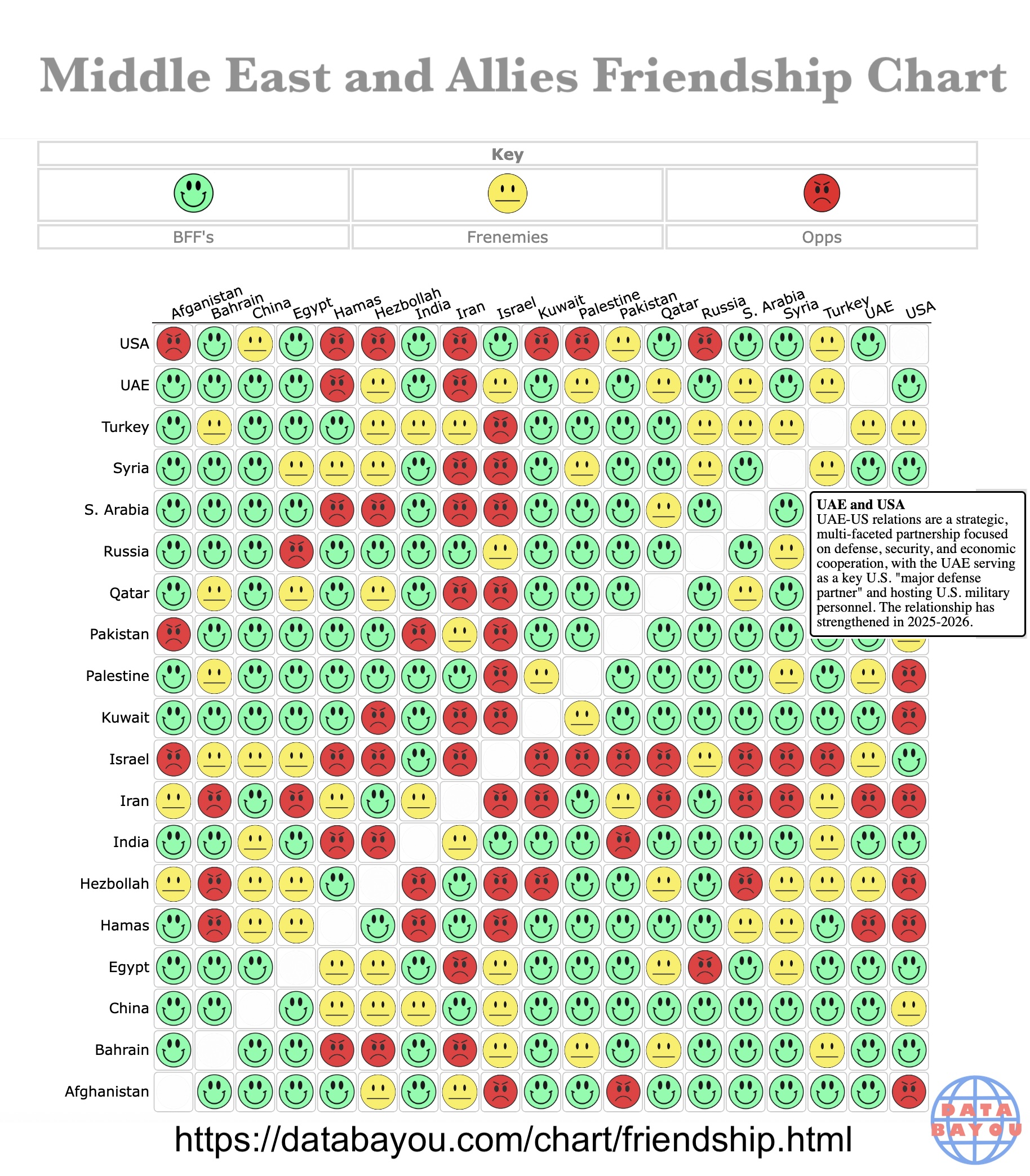
This is an interactive Friendship Chart of the Middle East and its Allies. It displays friends and foes of each country or group in the region. For details hover over the chart. For more information, scroll down.
Key
BFF's
Frenemies
Opps
Friendship Chart
While I was creating Iran's Military Bases Map I realized I did not know why Iran was counter attacking many of Middle Eastern countries.
I did a quick search of each, but it was overwhelming. Too much history and too many countries.
I remembered there was a Middle East Friendship Chart from Slate. I found it, but realized it was not current and did not have many of today's main players.
Furthermore, many of these countries had switched sides several times since that chart was made.
Just the change in presidents and leaders resulted in opposite postures. Geopolitics is not for the faint hearted.
I then realized I needed to make a newer broader one, with allies.
It is hard to summarize the history of the Middle East, when history itself started there. Nevertheless, oil and religion can explain its current state.
Judaism originated in today's Palestine and Israel 4000 years ago.
Christianity originated in the same area 2000 years ago and it spread from there to the rest of the world.
Islam originated in Mecca, modern day Saudi Arabia, 1400 years ago. It mainly spread to the Middle East and North Africa.
Muslims had a dispute over leadership in the 7th century and it branched between Shia and Sunni Muslims. Most Shia live in Iran and surrounding areas.
Here lies the first rift between Middle Eastern countries.
Many of these countries are theocratic and the discovery of oil brought western industries and workers with different views and attitudes.
The reaction to these foreign people and ideas was belligerent.
Furthermore, the injection of billions of dollars in these countries thanks to oil production gave these nations the chance to influence the political agenda of their poorer neighbors.
In 1948 Israel was established. Its creation displaced Palestinians, and its expansion resulted in hostility from the neighboring countries.
This book is a comprehensive yet accessible political history of the state of Israel from its inception to present day, from Daniel Gordis, "one of the most respected Israel analysts" (The Forward) living and writing in Jerusalem.
Global Connections
As if the world didn't have enough mishaps, in 2022 Russia decided to invade Ukraine. This event resulted in a radical response from NATO countries.
Russian oil and products were sanctioned. The world became polarized for or against Russia, including many Middle Eastern countries.
BRICS countries (Brazil, India, China, and South Africa) and Iran did not follow this sanction path.
Given this broad background there are several Middle Eastern countries that have had a profound effect in its neighbors
Afghanistan
After 9/11 and the retreat of U.S. power from Afghanistan, the country has fallen back into a theocratic rule by the Taliban.
The new Taliban-led government has been recognized by one country, Russia. Eventhough Russia invaded Afghanistan in 1980.
Besides the lack of human rights in Afghanistan, the country has also failed to keep good relations with its neighbors.
After being close allies Pakistan conducted air strikes in Afghanistan in 2026, due to the incursion of Afghan militias.
Syria
The Assad regime in Syria, under Bashar al-Assad (2000–2024), was a brutal authoritarian dynasty characterized by extreme repression, institutionalized torture, and widespread human rights violations.
This regime was propped up by Russia and Iran.
After the fall of the regime, the country has improved its relations with many of its neighbors, resulting in a wave of new alliances and cooperation in the Middle East.
Iran's international affairs may be summarized as:
The elimination of foreign influence and the spread of Islamic revolution over state-to-state relations or the furtherance of trade.
In Khomeini's own words:
We shall export our revolution to the whole world. Until the cry "There is no God but Allah" resounds over the whole world, there will be struggle.
This ideology has promoted instability in the region. Not only because of its theocratic stances, but its branch of Islam, which is different to its neighbors.
Furthermore, the attacks of March 2026 included allies like Qatar.
This book is a stunningly revelatory narrative history of the Iranian Revolution, one of the most momentous events in modern times.
Qatar
Qatar has cultivated close relationships with Western powers, particularly the United States and the United Kingdom, hosting American and British air forces.
At the same time, Qatar maintains ties to Western adversaries, including Iran, Hamas, the Muslim Brotherhood, and extremist elements in Syria.